Asset lifecycle management is often treated as an operational necessity. Something that sits between maintenance, procurement, and day-to-day coordination. Important, certainly, but not always discussed as a direct driver of financial performance.
In asset-intensive organizations, asset lifecycle management sits much closer to the heart of operational performance and long-term financial resilience than many teams realize. When asset processes are fragmented, value leaks quietly across the business. When they are managed with clarity and coordination, organizations improves uptime, strengthens cost control, and extract more long-term value from every asset they own.
That was the core message of our recent webinar on the ROI of asset lifecycle management, led by our Chief Growth Officer, Mariy Filipov.
The point is that losses rarely begin with one dramatic failure. They build through repeated disconnects. Planning happens without enough operational visibility. Procurement decisions are made without a full picture of utilization. Maintenance teams work around incomplete service history. Finance sees asset value through a reporting lens, but not always through a current operational one. IT and digital teams are left stitching together ERP data, spreadsheets, and field tools just to maintain a partial view.
On their own, these gaps can look manageable. Over time, they accumulate into a material financial problem.
Where value is lost across the asset lifecycle
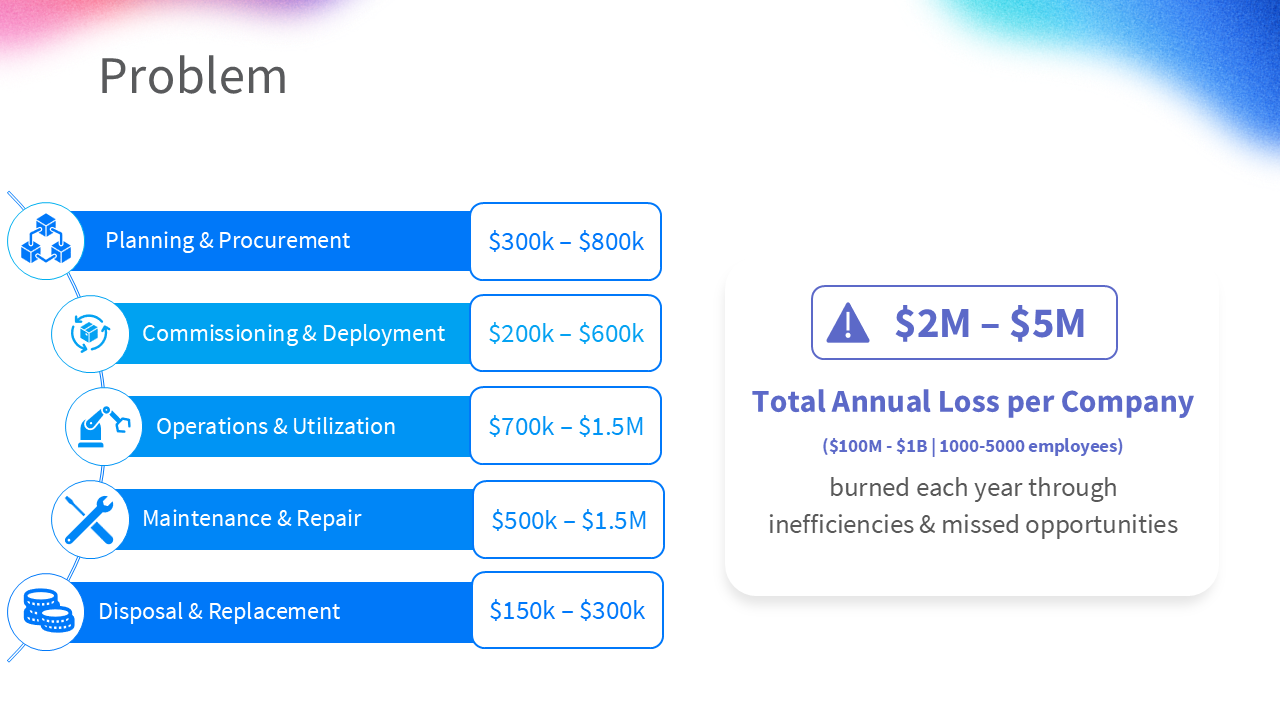
In 'The Shortest Friday Webinar on Asset Lifecycle Management', we broke the problem down across five areas where asset-intensive organizations typically see losses build over time.
The first area is planning and procurement, where poor forecasting and maverick spending lead to unnecessary costs. The second is commissioning and deployment. When teams aren’t aligned from the start, delays and rework erode an asset’s value before it even becomes fully operational.
Operations and utilization represent the largest source of value leakage. Assets sit idle in one part of the organization while other teams struggle with shortages.
The fourth area is maintenance and repair, where reactive fixes and inadequate documentation drive unplanned downtime, resulting in potentially staggering losses.
Finally, there is disposal and replacement, a stage where ghost assets, missed resale opportunities, and poorly timed replacement decisions can collectively account for significant financial value lost each year.
Taken together, these five areas represent a potential annual impact of roughly $1.85 million to $4.7 million across the asset lifecycle. That is why asset lifecycle management should not be treated as an administrative process. It is a significant financial concern, but also a major opportunity to obtain long-term value from existing assets.
Why these losses persist?
One reason these losses persist is that no single function sees the whole picture. Supply chain sees redundant purchases. Operations sees idle or unavailable equipment. Maintenance sees reactive work and poor planning conditions. Finance sees capital leakage and poor asset visibility. IT sees the integration burden created by disconnected systems.
These are different expressions of the same structural issue - fragmented asset lifecycle management. The ROI does not come from isolated improvement inside one team. It comes from improving how decisions are made across the lifecycle. If planning, operation, maintenance, and replacement are still managed as separate motions, the organization may improve local efficiency without recovering broader lifecycle value.
What changes when asset lifecycle management is done right?
The goal is to bring Finance, Operations, and Maintenance together over intelligent, value-driven planning and execution. By unifying how teams prioritize investments and track, maintain, and evaluate assets, organizations can unlock higher uptime, optimized costs, and stronger long-term value from every asset.
That framing matters. The value does not come from having more data in more places but from having a clearer operating picture that helps teams act with more discipline. When organizations get their asset lifecycle management approach right, three things tend to happen.
The first is higher asset uptime. Better lifecycle visibility makes it easier to move away from avoidable reactive work and toward more informed planning. That improves availability and reduces the operational disruption that comes with poor maintenance coordination.
The second is cost optimization. Organizations gain more control over purchasing, service activity, utilization, and replacement timing when they work from a more complete lifecycle picture. This reduces waste that often goes unnoticed when each function operates from partial information.
Third, stronger long-term asset value. Better lifecycle management supports more disciplined decisions about how assets are assigned, maintained, rotated, retired, and replaced. That helps organizations preserve value rather than lose it through poor timing or incomplete visibility.
How ROI builds over time?
Another useful point from the webinar was that lifecycle ROI is not something organizations have to wait years to see, even though the value can compound over time.
In the first year, organizations can reduce the financial impact of the most visible inefficiencies by 40–60%. This includes issues such as redundant purchases, missing service history, and idle equipment.
In year two, the value can deepen. As the asset data foundation improves, AI-driven capabilities can support more predictive and optimization-oriented decisions. Mariy highlighted examples such as proactive service recommendations, budget triggers when spend moves off track, and equipment rotation suggestions that help extend asset life. In the benchmark presented, this drives a 70–80% reduction in the problem areas over time.
The significance of these figures is not that every organization will follow the exact same path at the exact same speed. It is that asset lifecycle management becomes materially more valuable when it moves from fragmented administration to connected, data-informed decision-making. That is when investment in supporting technologies is recouped more quickly, and ongoing costs can be offset through measurable cost reductions.
The Conversation senior managers should be having
Asset lifecycle management should be treated as a financial and operational discipline, not just a supporting process. When it is fragmented, the business looses value across planning, procurement, operations, maintenance, and replacement. When it is done right, organizations improve uptime, strengthen cost control, and generate more long-term value from every asset.
That is the ROI conversation senior leaders should be having and it is a more useful one than talking about maintenance, procurement, or finance separately. The real opportunity sits in the connections between them.