Corporate News
Join Asset Insider as a Power Platform Engineer
Join our team as a Power Platform Engineer. Build enterprise-grade Asset Lifecycle Management solution for a global portfolio of customers.
Why asset lifecycle management breaks after the third site? Learn how coordination thresholds create hidden structural costs in multi-site growth.
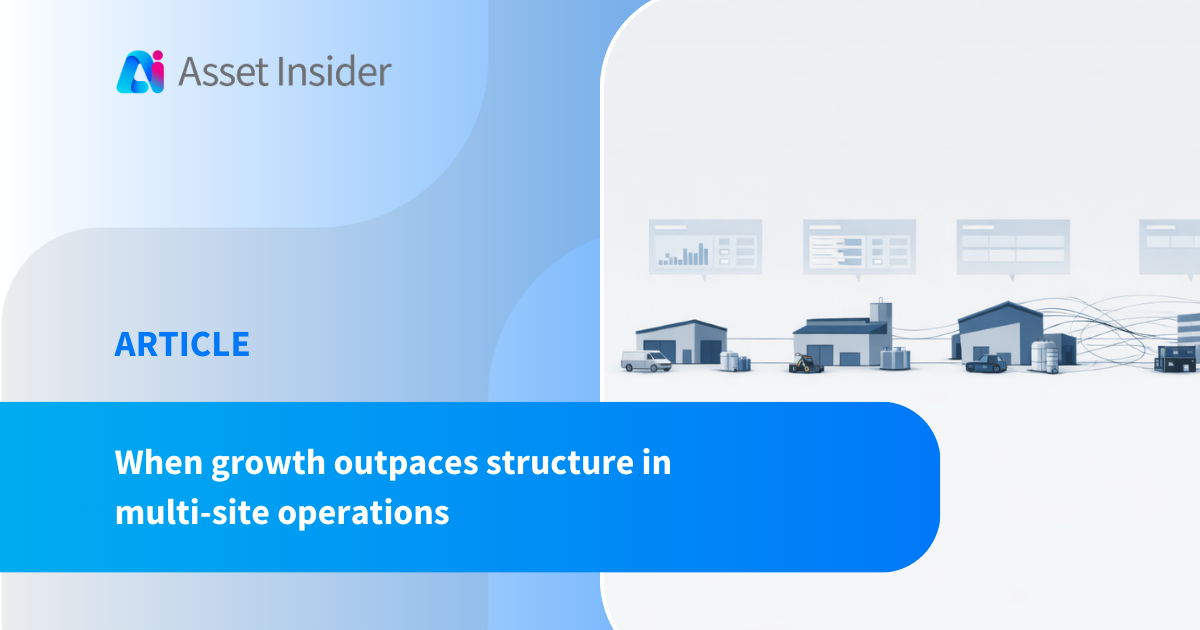
The first new location feels like progress. Depending on your industry, you may extend a facilities team maintenance routine to another building, or if you are a fleet operator, you might add vehicles to serve a new region. Manufacturers could open an additional production site and apply the same asset management standards already in place. The operating model remains intact; you simply cover more ground.
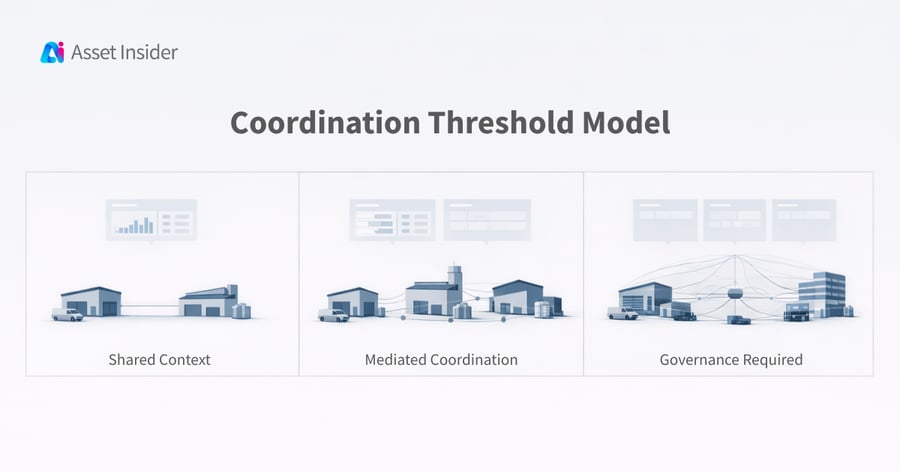
When a second location is added, coordination increases, but the organization still feels close to its assets. Team leads know the equipment. Schedules make sense without much explanation. If something diverges, it is discussed directly and resolved quickly. Asset lifecycle management continues to rely on familiarity and shared context rather than formal structure.
By the third or fourth location, that shared understanding becomes harder to sustain. The organization may use the same equipment fleet across sites. The same operating system is in place, and reporting still works. However, the way decisions travel begins to change. Information moves through more people before it reaches someone who can act on it. Standards that once felt self-evident now require clarification. Differences between sites begin to influence outcomes rather than simply vary in detail.
While nothing appears broken, what has changed is the load placed on coordination. Asset lifecycle management does not fail because your portfolio is multiplying. It becomes strained because the effort required to keep decisions aligned across locations increases.
Early multi-site growth works because the organization is still small enough to coordinate through people rather than structure. Knowledge moves through conversation and decisions are corrected through proximity.
At that stage, asset management depends less on formal governance and more on shared context. Leaders know why a replacement was postponed. Maintenance teams know which pieces of equipment tend to drift out of calibration. These details are not documented exhaustively because the organization remains close to its own operations.
That closeness narrows with each new location. The number of relationships that must remain aligned grows, and differences in asset portfolio, vendor availability, or workload patterns introduce interpretation where there was previously direct understanding.
Does asset lifecycle management immediately degrade under this pressure? First, people spend more time reconciling assumptions. Follow-up increases to confirm that standards are applied consistently. Conversations that once happened spontaneously now require scheduling. This marks the coordination threshold.
From that point forward, shared intuition is no longer sufficient. Coordination must be carried out by structure. If the organization lacks a deliberate model capable of absorbing variation across sites, alignment fragments.
Complexity becomes expensive when the effort required to keep decisions coherent exceeds what informal coordination can sustain.
When coordination begins to strain, people compensate. For example:
You can easily confuse this as leadership. When coordination depends on memory, interpretation, or individual initiative, the organization can continue operating without recognizing that its structure is under pressure.
At this stage, asset management practices still achieve their objectives. Standards appear to be applied, and reporting remains consistent. What changes is how much informal effort is required to sustain those outcomes. The adjustment feels manageable because capable people absorb the additional work.
This is how the silent tax accumulates. It’s difficult to measure because it rarely appears in performance dashboards. Asset management practices becomes dependent on individual intervention to maintain coherence. Activity scales faster than shared understanding, and over time effort rises even when performance appears stable.
The shift is gradual enough that it can pass unnoticed until growth adds another layer, and the margin for informal correction narrows further.
When organizations encounter strain at a new location, the first instinct is often to defend the existing model. The reasoning is straightforward: the process worked before, so the issue must be local.
In most cases, that statement is accurate. The practices that supported asset lifecycle management at one or two sites were effective within those conditions. They aligned with a smaller number of interfaces, shorter feedback loops, and a limited range of variation. The organization could rely on familiarity and direct oversight.
What changes with additional locations is not the logic of the process, but the context in which it operates. The same maintenance standards, reporting routines, and approval workflows now travel through more hands and interact with more variability. Decisions propagate further before their consequences become visible.
The difficulty lies in assuming that a locally effective model automatically scales. It does not fail because it was poorly designed. It begins to misalign because it was designed for a different coordination load.
“It worked before” is not evidence that it should continue to work unchanged. It is evidence that the problem it was solving was smaller.
At that point, asset management does not require better execution of the same model, but a recognition that the shape of the problem has shifted.
The effects of this threshold rarely surface at headquarters first. They become visible at the branch level, where centrally defined expectations meet local conditions.
Branches operate between planning and execution. They receive standards and investment decisions shaped by aggregated views of the organization, yet they must apply them within a specific asset mix, workforce capability, and vendor landscape. As locations multiply, the gap between assumption and application widens.
At first, adjustments are minor. For example, a centrally defined maintenance interval may assume a uniform equipment fleet and predictable vendor response times. A branch operating with older equipment or constrained supplier access will interpret that standard differently in practice. The adjustment is rarely escalated; it is absorbed locally to keep operations stable. Reporting continues to reflect adherence to the standard, even though the way it is applied has shifted.
Over time, these local decisions accumulate into patterns. Branches develop their own sequencing habits, documentation shortcuts, and interpretation norms. Reporting upward may still indicate compliance, but the way standards are actually applied begins to vary. The organization continues to function, yet the model operating at branch level no longer mirrors the model assumed at the center.
Because branches are evaluated on outcomes, they absorb the friction required to keep performance stable. The divergence becomes normalized and it presents as pragmatism.
This is where asset lifecycle management begins to separate into two versions: the formal one reflected in standards and reports, and the operational one embedded in local practice.
The cost of that separation is not immediately financial. Learning no longer accumulates evenly across sites, and decisions made centrally lose sensitivity to how assets behave in practice.
The impact of this shift accumulates in the background of daily work. Planning cycles take longer as assumptions require validation across sites. Decisions that once moved directly into execution may pause for confirmation that standards are being applied consistently. When discrepancies surface, they require reconciliation rather than immediate correction. Gradually, the organization spends more time aligning interpretations than improving performance.
As differences between sites widen, effort shifts toward maintaining consistency. Adjustments are made locally, yet they do not reliably inform future planning in a structured way. Experience remains valuable, but it does not consistently accumulate across locations.
Over time, feedback loops extend. By the time asset performance data is consolidated and reviewed, the conditions that shaped it may already have changed. Interventions respond to what is visible in reporting rather than to what is emerging in operations. Work continues, and from the outside, performance may appear stable. Internally, however, sustaining that stability requires increasing coordination.
Crossing the threshold introduces misalignment. Left unaddressed, it reshapes how asset lifecycle management functions long before it is described as broken. Growth expands capacity, but it also introduces distance. When that distance is not carried by deliberate governance, it is absorbed through effort.
By the time asset lifecycle management begins to feel strained, the issue is rarely execution. The organization has expanded beyond the point where informal alignment can sustain coherence across locations.
What worked at one or two sites was bounded. Once coordination crosses a certain threshold, the model must evolve. Without deliberate governance, variation accumulates faster than shared understanding, and increasing effort becomes the mechanism that holds outcomes together.
The shift is gradual enough to be rationalized. Growth appears successful and activity remains high, yet the cost of maintaining alignment rises in the background.
The question is not whether asset lifecycle management can function across multiple locations. It can. The question is whether the organization has designed a structure capable of carrying variation without relying on informal correction.
For a deeper breakdown of how this structural strain develops across headquarters, branches, and the field, see the hidden cost of scale in asset lifecycle management.
Join our team as a Power Platform Engineer. Build enterprise-grade Asset Lifecycle Management solution for a global portfolio of customers.
Enjoy streamlined service requests, enhanced work order management, and mobile access for efficient field operations with the new Asset Insider...
Where asset-intensive organizations loose millions and what are the key strategies they can employ for long-term success?