Asset Intelligence at scale: Why Control Erodes as Organizations Grow
With organizational growth, decisions about assets become harder to make with confidence. And this is not because information is being lost, as is often assumed. The information is here. But over time, it no longer reflects reality reliably, and it becomes increasingly disconnected from decision-making.
Businesses invest in their expansion and asset decisions span more locations, more teams, more vendors, and longer lifecycles. Leadership teams continue to receive reports from systems that remain in place. Yet each additional layer adds distance between where assets are used, where conditions are observed, and where decisions are made.
The connection between what is decided centrally and what happens across sites, teams, and equipment weakens. The organization still looks controlled on paper, but day-to-day outcomes become less predictable.
This is the moment when asset visibility starts to break down because growth introduces complexity that existing asset practices were never designed to govern. What worked when operations were smaller and more homogeneous begins to strain under scale.
This article explains why that loss of control happens, why it often goes unnoticed until it becomes expensive, and why it is fundamentally an organizational problem rather than a tooling one.
Growth introduces more assets, more locations, and more people involved in asset decisions. What it also introduces, albeit less visibly, is a growing gap between where decisions are made and where assets are used and maintained.
In the initial stages, this gap is small enough to ignore. Teams share context informally and notice exceptions quickly. Decisions are corrected through proximity and personal knowledge. Asset tracking feels sufficient because the organization itself acts as the coordinating mechanism.
With continued growth, coordination weakens. Assets are spread across sites, and responsibilities are distributed across roles. Local conditions vary, and decisions rely increasingly on reports and standardized views of reality. None of this is inherently wrong, but it changes the nature of control.
This is where the silent tax of scale appears.
It exposes the fact that most asset management tools were designed to support local execution or record-keeping, rather than governing decisions across a growing organization. These tools continue to function as intended, but the organization begins to rely on them for purposes they were never built to serve.
Over time, the consequences accumulate. Leaders see activity without always understanding impact. Field teams execute work without full visibility into priorities upstream. Increasing effort is spent reconciling information, explaining variances, and reacting to outcomes that should have been anticipated.
Operating blind at scale is rarely the result of neglect. It is the cumulative cost of growth without a governing structure for asset management decisions.
The Limits of Traditional Asset Management Tools
Most organizations can choose suitable solutions for their asset management needs. In fact, many of the tools in place are widely adopted, well-implemented, and operationally useful. The problem emerges when the role they are expected to play changes as the organization grows.
Spreadsheets, CMMS platforms, ERP asset modules, and specialized point tools each serve a legitimate purpose within defined boundaries. At smaller scales, those boundaries often align closely with how the organization operates. Asset decisions tend to be local, and they can be corrected quickly when reality diverges from plan. Tools support this environment well because the organization itself provides coordination.
At larger scales, ownership over asset decisions begins to fragment. Coordination no longer happens naturally; thus, information is created and maintained in different places, by different teams. No single system is responsible for governing how asset-related decisions connect across the lifecycle stages. Each tool optimizes its own domain, while the organization assumes coherence will emerge automatically.
Spreadsheets remain effective for local analysis and control, allowing teams to model scenarios. However, they enable flexibility at the cost of shared structure. As their use expands across sites and functions, versions multiply out of control and decisions rely on locally maintained logic that is difficult to validate or reconcile at scale. The spreadsheet still works but only within the context it was created for.
The same pattern appears in operational systems. CMMS platforms capture activity accurately and support execution well, yet they rarely govern how maintenance decisions relate to financial priorities or cross-site trade-offs. Financial systems formalize asset records and controls, but they abstract away operational reality. Specialized tools add clarity within their narrow scope while increasing fragmentation elsewhere.
Integration may move data between systems, but it does not resolve who owns decisions when priorities conflict. The common thread across these tools is the absence of governance even though they are doing exactly what they were designed to do. What’s worse is that organizations rely on them to provide something they were never built to offer: a shared structure for governing asset-related decisions across an expanding organization.
Reporting turns into a proxy for control. Decisions' quality begins to decrease, exceptions become harder to explain, and outcomes diverge from plans more frequently.
Traditional asset management tools fail because they were never meant to govern complexity across an expanding organization. They optimize execution, and that distinction matters at scale.
Complexity as a Structural Challenge in Asset Management
Complexity is often treated as a failure state. When asset visibility declines or decision-making slows, the instinct is to simplify operations. That can work at small scales, but at larger scales it usually backfires.
Complexity is not a sign that something has gone wrong. It is the natural result of growth, specialization, and distribution. Organizations expand across sites because they need proximity to customers and resilience in operations. Assets diversify because different contexts demand different capabilities. None of this is accidental or irrational. What changes at scale is the organization’s ability to govern complexity.
In smaller operating environments, asset decisions are made close to execution, and complexity remains manageable. Context travels informally; trade-offs are visible, and accountability is relatively clear. When decisions begin to span functions and locations, informal coordination stops working. The organization is no longer small enough to rely on shared intuition.
This is where many organizations misdiagnose the problem as having too many systems, asset types, or sources of variation in the field. The failure is structural because complexity has outgrown the decision framework used to manage it.
The lack of a governing model turns complexity from an asset into a liability. Decisions become slower because there is no shared logic for prioritization, escalation, or trade-offs. Alignment erodes due to ambiguity.
Once again, the problem is the absence of a structure to manage complexity.
Operating Blind as a Structural Failure in Asset Lifecycle Management
Headquarters and Asset Decision-Making at Scale
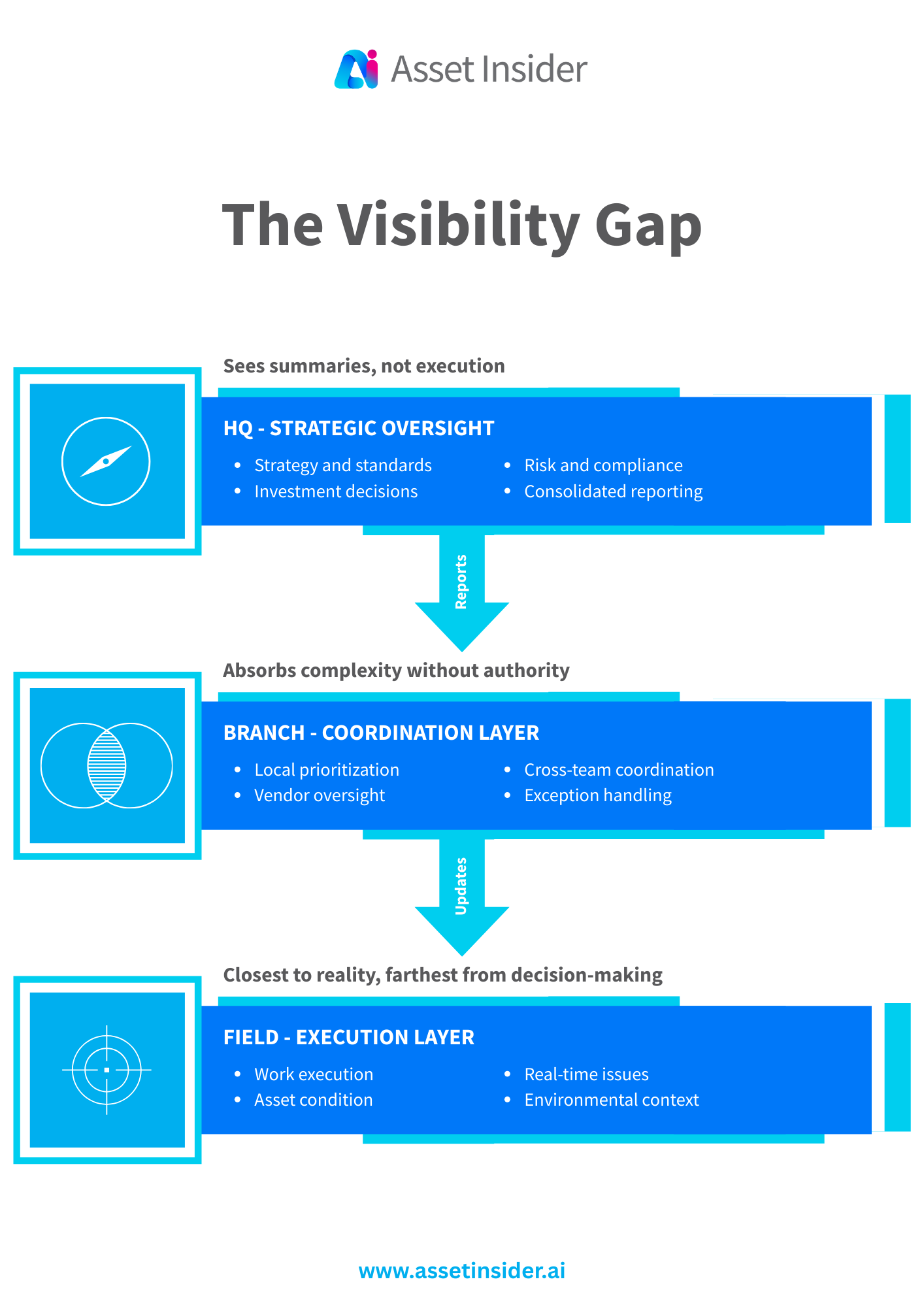
In asset-intensive organizations, headquarters is where asset decisions are expected to come together. From the outside, HQ appears to be the natural center of control:
At scale, this assumption becomes increasingly fragile. Headquarters relies less on direct knowledge of assets and more on representations of them. Information reaches decision-makers through layers of consolidation that make it possible to oversee large and distributed operations. This abstraction is necessary, but it also reshapes how reality is perceived. By the time asset conditions and performance reach HQ, they have been simplified to enable comparison, prioritization, and reporting across the organization.
The result is distance, changing the nature of decision-making. HQ typically has access to extensive asset-related information. What diminishes over time is not visibility in the literal sense, but confidence in how closely reported signals reflect conditions on the ground. Patterns are visible, but their causes are harder to trace. Variance appears after it has already materialized in operations. Decisions are made with an understanding that conditions differ across sites, yet without a reliable way to account for those differences consistently.
Decisions made at HQ increasingly rely on lagging signals. Issues surface after they have already affected operations. Interventions are framed at a level that assumes consistency across sites, even when conditions differ materially. This is yet another structural consequence of scale that can be mistaken for poor leadership or inattentiveness.
Headquarters continues to make decisions, with growing uncertainty about their downstream effects. Direction is provided through policies, targets, and reporting, while day-to-day asset behavior evolves elsewhere in the organization. Formal control remains intact, even as informal confidence weakens.
Operating blind at HQ describes a situation where oversight exists, but is increasingly mediated by abstraction rather than proximity to execution.
Why Asset Coordination Degrades at Branch Level
In growing organizations, branches take on responsibility for turning centrally defined plans into operational outcomes. They are expected to translate standards into action, coordinate work across assets and teams, and reconcile central direction with local conditions. At smaller scales, planning assumptions and operational reality remain closely aligned. As scale increases, that alignment weakens.
Branches sit downstream from headquarters decisions and upstream from field execution, but without full control over either. Branch-level teams receive plans and priorities shaped by aggregated views of the organization. Those plans assume a degree of consistency across sites that rarely exists in practice. Asset condition, workload patterns, and operational constraints vary by location, yet those differences are only partially visible at the point where decisions are made.
To keep operations moving, branches adapt. They adjust sequencing, reallocate effort, and introduce local practices that bridge gaps between plan and reality. Over time, these adaptations become embedded in how work is coordinated locally. The organization continues to function, but coordination increasingly depends on informal judgment rather than shared structure.
What begins as pragmatic coordination gradually turns into fragmentation. Different branches solve similar problems in diverse ways because standards cannot account for local conditions consistently. Accountability becomes blurred as outcomes depend on factors neither fully local nor fully centralized. When issues surface, it is often unclear whether the cause lies in planning, prioritization, execution, or coordination across sites.
This is where operating blind becomes expensive. Branches carry responsibility for performance without having full visibility into the assumptions behind upstream decisions, and without a shared structure for feeding operational reality back into future planning. Reporting flows upward, but it rarely captures the trade-offs branches make to keep work moving. Over time, coordination effort increases and confidence in alignment decreases, even though activity levels remain high.
From the outside, branches appear busy and responsive. From the inside, they absorb growing friction and lose the ability to keep planning and execution connected.
The Field and the Loss of Asset Visibility
The field is where assets are used and exposed to real operating conditions. This is where wear becomes apparent and where constraints first appear. Field teams encounter these conditions directly as part of their daily work.
At limited scale, this proximity supports fast correction. Observations circulate through conversation and immediate follow-up. Decisions adjust because the path between what is observed and what is decided remains short.
At larger organizational scale, field teams continue to work much in the same way. They notice early signs of degradation and make practical choices to keep operations running. Much of this knowledge remains situational and time-sensitive. Capturing it consistently becomes harder as asset volumes increase, and work is distributed across more people and locations.
Field observations are recorded selectively, if at all. They are shaped by individual interpretation or constrained by predefined reporting structures. These structures prioritize classification over context. Information arrives after decisions have already been made, or in a form that no longer reflects the conditions that triggered it.
Decisions upstream rely on signals that describe past states rather than present conditions. Variability increases at the point of execution even as reporting suggests stability. Interventions address symptoms that have already propagated through operations. Field teams continue to compensate locally to avoid disruption.
How Organizations Begin Operating Blind Across the Asset Lifecycle
With organizational scale, loss of control over assets does not occur at a single point. It develops across layers of the organization, each for different structural reasons. At headquarters, decisions rely increasingly on abstracted representations of reality. At branch level, coordination compensates for gaps between plans and local conditions. In the field, operational reality is observed directly, but enters decision-making late and in reduced form.
The organization remains active and responsive because individually none of these conditions appear problematic. However, the coherence between these layers changes.
Over time, decisions are made with growing uncertainty about their downstream effects. Adjustments are made locally without shaping future plans. Operational knowledge fails to accumulate across cycles. Reporting increases, but confidence in outcomes does not.
This is how organizations begin operating blind at scale. Not because data disappears, and not because teams fail to act, but because the structures connecting observation, coordination, and decision-making no longer hold the asset lifecycle together.
The problem reflects an organizational condition that emerges gradually as scale outpaces the ability to govern asset-related decisions coherently.
What Operating Blind Costs Asset-Intensive Organizations
At scale, this condition expresses itself through the accumulation of small decisions made with incomplete grounding. Individually, these decisions are rarely controversial. The impact is felt differently across the organization, yet it stems from the same underlying condition: decisions are made without a reliable connection to asset reality across the lifecycle.
For Finance, the cost appears as unpredictability. Asset-related spending become harder to forecast because underlying assumptions change faster than plans are updated. Budget variance increases even when controls remain in place. Capital decisions are revisited more often because prior choices were based on incomplete or outdated understanding of asset condition and performance. Oversight shifts toward explaining variance rather than shaping intent, even when controls remain formally intact.
Operationally, the cost appears to be a sustained coordination effort. Work continues, and assets remain productive, but maintaining that continuity requires constant adjustment. Schedules are reworked, priorities shift, and dependencies are managed reactively. Time that could be spent improving reliability or throughput is redirected toward keeping plans viable under changing conditions.
What Asset Intelligence Really Means in Complex Organizations
Asset intelligence is often treated as an analytical capability. In many organizations, it is associated with dashboards, reporting layers, or advanced analytics applied to asset data. These interpretations focus on visibility, but they stop short of addressing the condition described throughout this article.
At scale, asset intelligence is about enabling decisions to remain connected to reality across the asset lifecycle stages. In complex organizations, asset-related decisions are made over long time horizons and across multiple layers. Investment choices shape years of operational behavior. Maintenance priorities influence asset longevity and risk exposure. Replacement decisions depend on how assets have actually performed, not how they were expected to perform. Asset intelligence exists when these decisions are informed by accumulated, contextual understanding rather than isolated signals.
This requires more than data availability. Asset intelligence implies continuity. Observations made in the field must inform coordination at branch level and influence decisions at headquarters. Local adaptations should shape future planning rather than remain situational. Knowledge about asset behavior needs to persist across cycles, locations, and organizational change.
Without this continuity, insight remains episodic. Organizations see fragments of reality at different moments, but they cannot build on them. Decisions rely on snapshots rather than on evolving understanding of how assets behave over time.
Asset intelligence also implies governance. Not governance in the sense of control or restriction, but in the sense of shared logic. There must be clarity around how asset-related information is interpreted, how trade-offs are evaluated, and how decisions propagate across the organization. Without this, visibility increases without improving decision quality.
In this sense, asset intelligence is not an outcome of better tools or more advanced analytics. It is an organizational capability that determines whether scale amplifies learning or erodes confidence.
This distinction matters because many organizations invest in visibility and expect intelligence to emerge. At scale, it does not. Intelligence requires structure that connects observation, coordination, and decision-making across the asset lifecycle.
When Asset Lifecycle Blindness Becomes Unavoidable
For many organizations, operating blind emerges gradually, masked by expansion, activity, and continued delivery. There are, however, conditions under which this state becomes difficult to ignore.
One of those conditions is expansion across sites. As assets spread geographically, direct familiarity with their use and condition diminishes. Decisions that once relied on shared understanding begin to rely on abstraction. What was previously corrected through proximity now requires formal coordination, and the limits of existing structures become apparent.
Another condition is increased reliance on external parties. As maintenance, operations, or service delivery are outsourced, asset reality becomes mediated through contracts, reports, and interfaces. The organization remains accountable for outcomes, yet has fewer opportunities to observe how assets are actually treated in daily use.
A similar shift occurs as field work becomes more distributed. Larger teams, higher turnover, and mobile workforces reduce continuity of knowledge.
Observations are made, but they are harder to retain across time. What the organization learns about its assets becomes fragmented across people rather than accumulated institutionally.
Financial scrutiny can also surface the issue. As capital allocation becomes more constrained, decisions depend more heavily on understanding asset performance over time. When that understanding is incomplete, planning cycles shorten, revisions increase, and confidence in long-term choices declines.
These conditions expose the problem. Organizations often reach this point while their tools still function, and their processes still operate. What changes is the organization’s tolerance for uncertainty. The cost of misalignment increases, and the margin for compensating through effort narrows.
At that stage, operating blind becomes a constraint on growth, resilience, and decision-making.
From Asset Visibility to Asset Intelligence
Most organizations recognize the effects of operating blind before they can articulate the cause. Effort increases, coordination becomes heavier, and confidence in outcomes erodes, even as systems continue to run, and work continues to get done.
What this reveals is not a lack of capability, but a structural limitation. As organizations scale, the question is no longer whether assets are tracked or maintained, but how decisions, accountability, and execution relate to one another across headquarters, branches, and the field.
This is where approaches that work in isolated contexts begin to lose effectiveness. Without a structure designed to accommodate organizational complexity, local success does not translate into system-wide control.