Asset Lifecycle Management in manufacturing operations
In manufacturing, fragmented asset management shows up as missed production windows, reactive maintenance, and capital plans built without evidence.
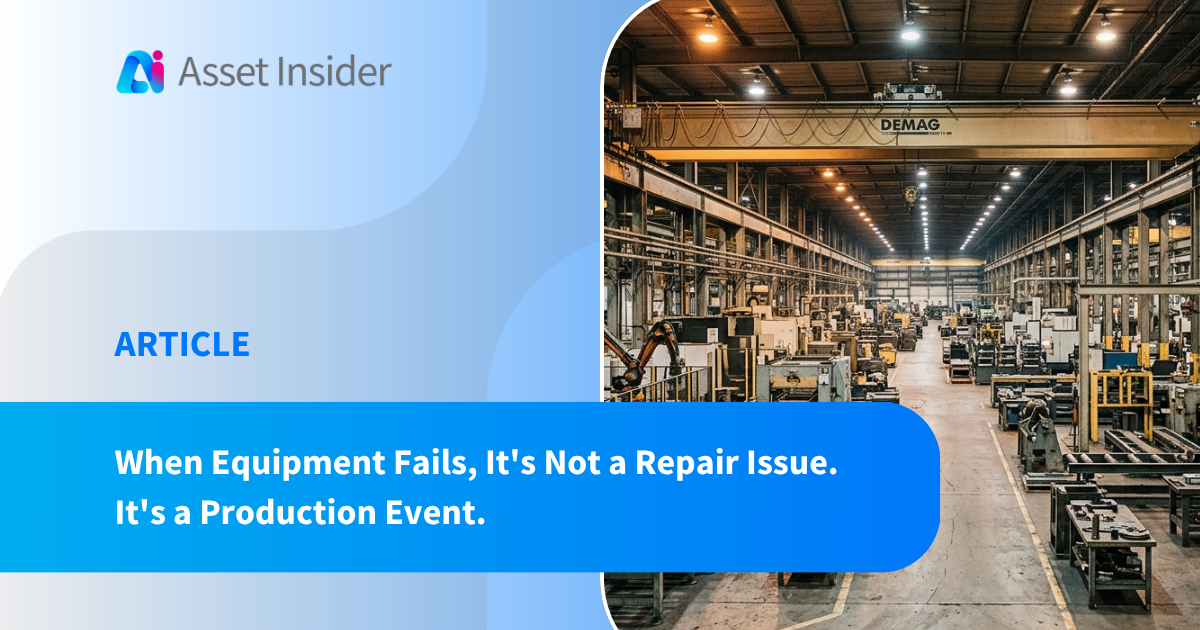
When asset information is fragmented in a manufacturing environment, the cost does not stay inside a maintenance backlog. It shows up as missed production windows, overtime, expedited parts, quality risk, and capital decisions made without enough operational evidence. A failed production asset is rarely just a repair issue. It changes what the plant can produce, when it can produce it, and how confidently leaders can commit to output.
This is why the asset lifecycle management approach manufacturing leaders need goes beyond asset tracking alone. The asset record matters, but the record is only useful when it connects condition, maintenance history, utilization, production impact, and capital planning. Without that connection, Maintenance may know which equipment is becoming unreliable, Operations may feel the effect on throughput, and Finance may still be working from depreciation schedules and budget assumptions.
The gap becomes more expensive as asset portfolios grow. A single plant can often work around informal knowledge and local workarounds. A multi-plant manufacturer cannot. As equipment, locations, teams, and production schedules multiply, fragmented asset management becomes a structural constraint on output, reliability, and investment discipline.
The Manufacturing Asset Challenge and Why It Is Different
Equipment criticality
When an asset fails, it's not an inconvenience but a production event. Manufacturing asset management starts with a direct relationship between equipment performance and production capacity. When a critical conveyor stops, a packaging line loses throughput.
This is why criticality scoring in manufacturing cannot remain a static planning exercise. It needs to reflect the real production role of the asset, the cost of downtime, the availability of backup capacity, and the operational consequences of failure. Two machines may look similar in an asset register, but their business impact can be completely different depending on where they sit in the production flow.
Asset management that does not account for criticality becomes record-keeping. It may identify what the organization owns, where equipment is located, and when maintenance was last completed. It does not help leaders understand which assets carry the greatest operational exposure or where limited maintenance and capital resources should be focused first.
Multi-plant asset portfolios
Manufacturers with multiple plants face a coordination challenge that is more complex than a larger asset list. Equipment may vary by plant, production line, age, maintenance practice, operating conditions, and local team habits. Over time, each location develops its own system of record keeping and asset management.
These differences create friction when corporate Operations, Maintenance, and Finance teams need to compare performance across plants. One plant may classify an asset as critical because of production dependency. Another may classify the same asset type differently because backup capacity exists. A third may not have updated criticality, condition, or cost history in a consistent way.
The result is uneven decision quality. Maintenance decisions are made locally without enough shared context. Capital planning depends on estimates rather than comparable lifecycle evidence. Operations leaders cannot reliably distinguish whether reliability issues reflect equipment condition, maintenance practice, or how intensively a line is run.
The maintenance-production tension
The tension between Maintenance and Production is often described as a people issue. In most cases, it is a visibility issue. Maintenance needs planned downtime to perform preventive work, inspections, lubrication, calibration, and component replacement. Production needs equipment availability to meet output targets, customer commitments, and utilization goals.
Both priorities are legitimate. The conflict persists because each function often sees a different version of the asset reality. Production sees the immediate cost of taking equipment offline. Maintenance sees the future risk of deferring work. Finance sees the budget impact of both, but may not have enough operational context to evaluate the trade-off.
When shared asset condition data is weak, decisions become negotiations between competing assumptions. Preventive work gets pushed because the risk is not visible enough. Production schedules absorb more reactive events later. Maintenance loses credibility when it cannot show clear evidence, and Production loses confidence when equipment failures interrupt planned output.
Where Asset Management Breaks in Manufacturing
Maintenance data that doesn't inform capital decisions
Maintenance teams often hold the most valuable lifecycle knowledge in the manufacturing environment. They know which assets fail repeatedly, which parts are becoming difficult to source, which machines require excessive labor, and which repairs are no longer extending reliable service life. This information accumulates through work orders, inspections, technician notes, downtime history, and repair cost records.
The problem is that this knowledge often remains inside a CMMS or local maintenance workflow. Finance may see maintenance spend as a cost category, but not the operational story behind it. Operations may see production disruption, but not the full cost pattern behind repeated failures. When maintenance data does not inform capital decisions, some assets are replaced too early while others are kept too long. Both outcomes carry cost.
Capital plans built on financial depreciation, not operational condition
Depreciation is necessary for accounting. It is not enough for equipment lifecycle management. A manufacturing asset that is fully depreciated may still have productive life if condition, utilization, and maintenance cost remain stable. Another asset that still carries book value may be approaching a reliability threshold that threatens production continuity.
This divergence grows over time. Equipment ages differently depending on operating hours, load, environment, maintenance discipline, operator behavior, and process intensity. Two identical assets purchased in the same year can have different remaining useful lives if one runs continuously in a high-demand line while the other supports intermittent production.
Capital planning based mainly on depreciation creates a false sense of order. It gives Finance a schedule, but not a complete view of operational risk. Stronger manufacturing capital planning connects book value with condition data, utilization trends, maintenance cost history, and production criticality.
Reactive maintenance cycles that compound over time
Reactive maintenance is not only more expensive when it happens. It changes the maintenance pattern that follows. Emergency repairs interrupt schedules, consume technician capacity, increase overtime, and create pressure to return equipment to service quickly. That pressure can reduce the time available for root cause analysis and planned corrective action.
When preventive maintenance is deferred, the organization may gain production time in the near term. The trade-off appears manageable until failures become more frequent, repairs become less predictable, and downtime windows become harder to control. Reliability degradation rarely arrives as one dramatic event. It builds across maintenance cycles.
This compounding effect matters because manufacturing environments operate on rhythm. Production schedules, labor planning, materials flow, and customer commitments depend on equipment availability. As reactive work increases, the plant loses more than repair hours. It loses planning confidence.
What Connected Asset Lifecycle Management Looks Like in a Production Environment
Maintenance and production planning coordinated around asset condition data
A connected ALM approach does not remove the tension between Maintenance and Production. It gives both functions a better basis for decision-making. When maintenance scheduling is informed by condition data from IoT sensors, inspections, operational monitoring, and work order history, planned downtime can be discussed with clearer evidence.
For example, vibration, temperature, pressure, current draw, runtime, and inspection data can help identify when equipment is moving outside acceptable operating patterns. Maintenance can use that context to recommend work before a failure becomes a production event. Production can evaluate the timing against output commitments and line availability.
The result is not perfect agreement every time. Manufacturing leaders still need to make trade-offs. The difference is that the trade-off becomes explicit: defer work and accept a quantified risk, or schedule intervention and protect future reliability.
Capital decisions grounded in equipment cost history and remaining useful life
Connected asset lifecycle management gives Finance, Operations, and Maintenance a shared basis for capital planning. Maintenance cost history shows what the asset has required over time. Utilization data shows how intensively it is used. Condition indicators show whether reliability is stable or deteriorating. Criticality data shows the production exposure attached to failure.
When these inputs are connected, replacement decisions become more defensible. A plant can justify extending the life of equipment that is reliable, under control, and economically sound. It can also justify earlier replacement when repair cost, downtime exposure, parts availability, and condition trends point to increasing risk.
This matters for capital discipline. Manufacturing organizations operate under budget constraints, and replacement decisions compete with other investments. A connected lifecycle view helps leaders prioritize assets based on cost, risk, and production impact, not only age or accounting schedules.
A shared asset view across plants, lines, and functions
In a connected asset lifecycle management environment, different stakeholders do not need identical screens, but they do need the same underlying asset context. A plant manager may need visibility by line, production impact, and open maintenance risk. A maintenance lead may need work order history, inspection results, parts, and condition alerts. A capital planning lead may need replacement candidates, lifecycle cost trends, and remaining useful life projections.
The value comes from alignment. When each function works from different asset records, decisions require reconciliation before the real discussion can begin. When the underlying asset model is shared, teams can filter and interpret the same data through their own responsibilities.
For multi-plant manufacturers, this also improves comparability. Leaders can see how similar assets perform across locations, where maintenance practices differ, where asset condition is deteriorating, and where capital requests are supported by operational evidence. That makes portfolio decisions more consistent without ignoring local plant realities.
The Role of Asset Intelligence in Manufacturing
Asset Intelligence becomes most valuable in manufacturing when it is tied to production risk, maintenance timing, and equipment criticality rather than treated as a broad technology layer.
From scheduled to condition-based maintenance in a production context
Scheduled preventive maintenance remains important in manufacturing. It creates discipline and reduces the chance that critical work is forgotten under production pressure. But calendar-based schedules are usually built around conservative assumptions because the cost of unexpected failure is high.
Condition-based maintenance changes the planning logic. Instead of maintaining equipment only because a date has arrived, teams can intervene when data indicates that intervention is needed. For critical production assets, this can reduce unnecessary maintenance on healthy equipment while bringing earlier attention to assets showing signs of deterioration.
This is where asset intelligence becomes operational rather than theoretical. IoT monitoring, inspections, anomaly detection, and reliability analysis can help maintenance teams understand asset condition in context. The purpose is not to replace maintenance judgment. The purpose is to give that judgment stronger evidence.
What AI-assisted anomaly detection adds to equipment monitoring
Equipment telemetry can generate patterns that are difficult for teams to evaluate manually at scale. Vibration, temperature, pressure, current draw, and runtime data may show small changes long before a failure is obvious on the production floor. AI-assisted anomaly detection can help identify these patterns and flag developing issues earlier.
The practical value is timing. A failure identified weeks earlier can be planned into a maintenance window, aligned with production schedules, and addressed with the right parts and labor. The same failure identified at the point of breakdown becomes downtime, production rescheduling, and often a more expensive repair.
For manufacturers with high-criticality equipment, the ROI logic is direct. One avoided production failure can justify a significant portion of the monitoring investment, especially when downtime carries hourly cost, quality risk, or customer delivery consequences. The important point is to apply asset intelligence where the operational case is strong, not to treat every asset as equally suited for predictive monitoring.
Closing
Asset Insider is a connected asset lifecycle management platform built natively on Microsoft Power Platform. It is particularly relevant for manufacturers already operating within Microsoft infrastructure who need to connect asset decisions across Finance, Operations, and Maintenance, from capital planning and maintenance management to IoT-driven condition-based maintenance through Asset Intelligence.
Asset Insider connects the asset lifecycle management capabilities described in this article in a single connected environment built on Microsoft Power Platform. If you'd like to see how this applies to your production environment, our team is glad to walk through it.